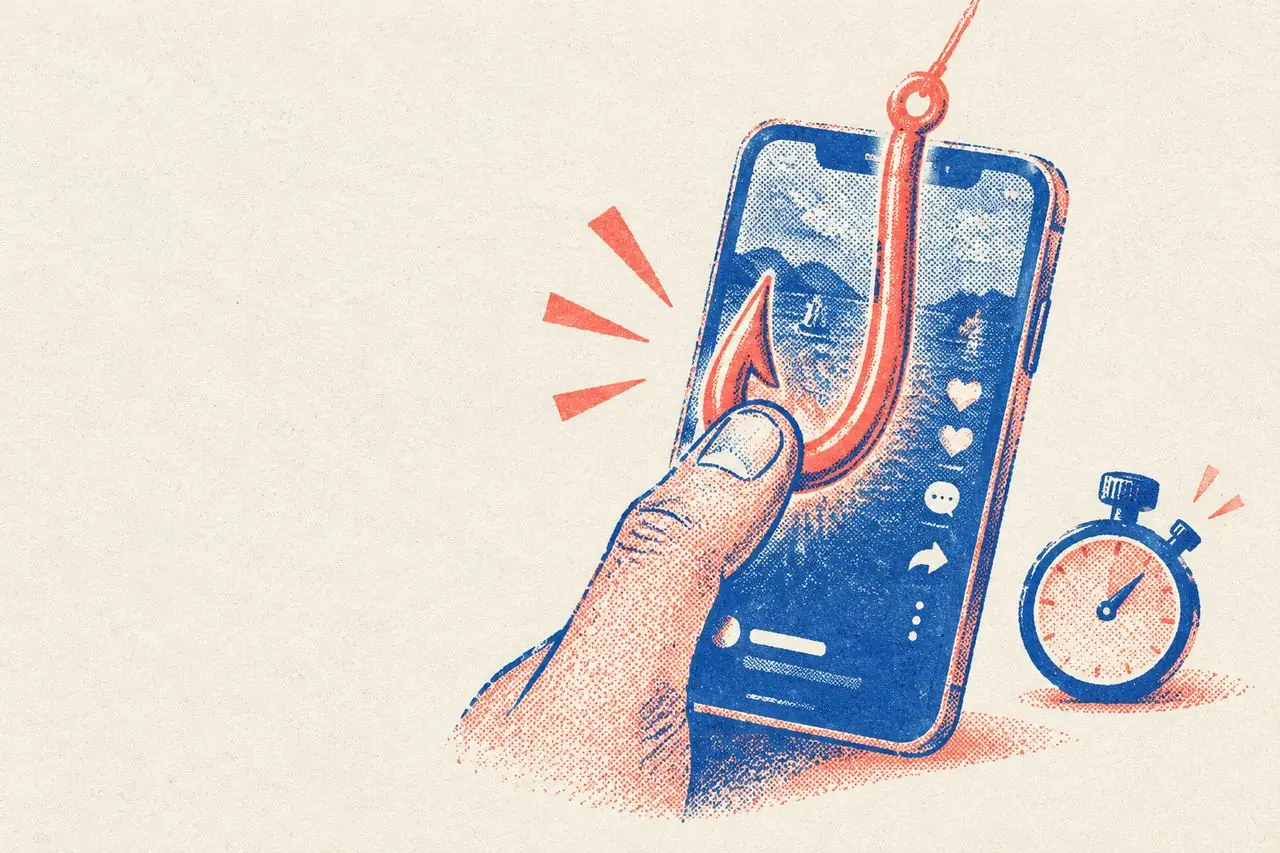
How to Hook Viewers in the First 3 Seconds: 5 Hook Types + 40 Copy-Ready Opening Templates
It takes a viewer less than 2 seconds to decide whether to keep watching or swipe past your video. In that split second, they aren't admiring your color grading or waiting for you to finish a sentence—their brain is making one snap judgment: "Does this have anything to do with me, and is something worth watching about to happen?" A hook is your answer to that question. This guide breaks proven short-video hooks into 5 clear categories, showing how each one works, how to shoot it, and how to write the opening line—complete with 40 templates you can adapt right away.
1. The Core Psychology: Open a "Gap" in the Viewer's Mind
Every hook that works is doing the exact same job underneath: prying open a gap in the viewer's head that they feel an itch to close.
- Suspense Hooks open an information gap — "Wait, what happens next?"
- Contrast Hooks open a logic gap — "How do those two things go together?"
- Visual Spectacle Hooks open a sensory gap — "Whoa, what am I looking at?"
- Pain Point Hooks open a need gap — "I have that exact problem—how do I fix it?"
- Conflict Hooks open an emotional gap — "Who's in the right here, and who wins?"
If your video opens with a flat announcement ("Today I'm going to share a tip about…"), you haven't opened a single gap—and the viewer has zero reason to stay.
2. The 5 Hook Categories
1. Suspense Hooks: Show Half the Result First
How it works: Hand the viewer an incomplete puzzle piece so they stick around to see the rest of the picture.
How to shoot it:
- Flash the dramatic ending first, then rewind ("Three months ago, I was still…");
- Hide half the frame: an eye peeking through a door crack, a hand covering a phone screen, cutting to black right before the reveal;
- Plant an eerie detail: five sets of bowls and chopsticks laid out on the dinner table when only four people live in the house.
Spoken Line Templates:
1. "I never in a million years guessed who would be standing on the other side of that door." 2. "Day 30 after quitting my job without a backup plan—and here's what's left in my bank account…" 3. "I kept this secret from my mom for an entire year." 4. "99% of people mess up the very last step." 5. "Watch till the end and you'll see why I walked out crying." 6. "When he moved out, this was the only thing he left behind." 7. "It cost me $5,000 the hard way to figure out how this actually works." 8. "If a text message like this pops up on your phone, do not tap it."
Best for: Story skits, personal stories, educational cautionary tales.
Watch out: You have to actually pay off the suspense before the video ends. Clickbait that leaves the question unanswered destroys viewer trust fast.
2. Contrast Hooks: Put Two Things Together That Don't Belong
How it works: Pair two things that clash against common sense so the viewer's brain stalls and says, "Wait—how?"
How to shoot it:
- Identity contrast: Someone in a three-piece suit hauling bricks on a construction site; a silver-haired grandma dominating an esports tournament;
- Setting contrast: Slurping instant noodles inside a luxury sports car; dancing ballet in the middle of a crowded wet market;
- Outcome contrast: Something that looks like a $500 designer piece but costs $15; a dish that looks Michelin-starred but takes two ingredients.
Spoken Line Templates:
9. "Making $500 a month, I moved into a lakefront apartment." 10. "I just turned 60, and I started taking hip-hop classes this week." 11. "This shirt cost me 6 bucks, and three coworkers asked me what brand it was today." 12. "The top salesperson at our company is someone who barely speaks in meetings." 13. "My mom taught school for 30 years—and she's terrified of going to parent-teacher night." 14. "The one food my doctor told me to eat more of was the last thing I expected." 15. "The kid who finished dead last in our class is now the only business owner from our grade." 16. "It looks like scrap metal, but gram for gram it's worth more than silver this year."
Best for: Almost every niche—especially personal branding, e-commerce, and transformation stories.
Watch out: The contrast has to be grounded in truth. Making up a fake backstory just for shock value gets exposed in the comments immediately.
3. Visual Spectacle Hooks: Stop the Eyes Before the Brain Catches Up
How it works: Put something rare, breathtaking, hypnotic, or bizarre on screen in frame one—no explanation needed.
How to shoot it:
- Surreal imagery: A city floating in the clouds, ocean waves crashing inside a teacup, a strawberry the size of a car;
- Extreme macro detail: A single water droplet hitting a surface in ultra-slow motion, chocolate melting and folding, everyday objects under a microscope;
- Seamless morphing: One object transforming smoothly into another in a single second;
- Extreme locations: The edge of a sheer cliff, the deep ocean floor, a lighthouse battered by a blizzard.
How to write the line: Visual spectacle hooks usually don't need any dialogue at all in the first two seconds—or just a single grounded sentence right after the visual lands ("Everything you're looking at was carved out of a bar of soap").
Best for: AI creative videos, food, crafts, travel & nature, high-concept product ads.
Watch out: A spectacle buys you 3 seconds, not 30. Once the eye candy lands, you still need a real story or point to carry the rest of the clip.
4. Pain Point Hooks: Name the Viewer's Exact Headache
How it works: Describe a frustration the viewer is dealing with right now so vividly that they think, "That's literally me."
How to shoot it:
- Re-create the exact frustrating moment: hunting for a matching sock while late for work, a phone battery blinking at 1%, a kid stalling over homework at 11 p.m.;
- Show the messy aftermath up close: a yellowed white collar, black mildew in the shower caulk, chapped winter lips.
Spoken Line Templates:
17. "Do you lie awake every night with your brain racing the second your head hits the pillow?" 18. "Closet packed to the brim, and you still stand there every morning with nothing to wear?" 19. "If your kid complains they're tired the second they open their workbook, try this tonight." 20. "Every pair of jeans that fits your thighs gaps two inches at the waist?" 21. "Renting a tiny room where half your winter clothes don't have anywhere to go?" 22. "Paycheck hits your account and vanishes in three days—where is it all leaking?" 23. "Hands freezing numb on the handlebars every winter morning commute?" 24. "Why do your slide decks always look like 2008 no matter how long you tweak the fonts?"
Best for: Product videos, how-to tutorials, educational tips, life hacks.
Watch out: Make the pain point hyper-specific. Asking "Do you ever feel stressed?" is too vague to register; saying "Does your stomach knot up every Sunday around 8 p.m. just thinking about Monday morning?" hits home immediately.
5. Conflict Hooks: Start in the Middle of the Fight
How it works: Humans are wired to stop and watch an argument. Dropping straight into a confrontation makes viewers stay to see who's right and how it ends.
How to shoot it:
- Cut in mid-argument rather than showing people walking into the room;
- Open with a sharp physical action: shoving a door open, slamming a folder on a desk, tossing a suitcase into the hall;
- Frame a clear power clash: one person standing and shouting, the other sitting dead silent.
Spoken Line Templates:
25. "Tell me right now—do you still want this family or not?" 26. "Who gave you permission to go through my things?" 27. "Nobody walks out that door until we settle this today." 28. "I'm saying this one last time: we are not lending them that money." 29. "Say that to my face one more time. I dare you." 30. "Fine. Starting today, we split everything down the middle." 31. "Your mom just showed up at the door again—and this time she brought three suitcases." 32. "With clauses like this, I'm not signing this contract."
Best for: Story skits, relationship drama, family conflict, workplace series.
Watch out: Viewers need to understand who is fighting and what they're fighting about within 2 seconds. If the conflict takes five sentences of lore to explain, save it for later in the video.
3. Stacking Two Hooks Together for Double the Pull
A single hook works well on its own, but combining two hook types hits even harder:
| Combo | Example |
|---|---|
| Pain Point + Contrast | "I used to lie awake until 3 a.m. every night—until I realized the problem wasn't my mattress, it was my pillow." |
| Conflict + Suspense | "She set her engagement ring on the dinner table, said one sentence, and the whole room went dead silent." |
| Spectacle + Suspense | A phone frozen solid inside a massive block of ice, with text on screen: "It's been in there for 24 hours." |
| Contrast + Pain Point | "Even on an entry-level salary, I saved $15,000 in two years just by killing this one habit." |
8 more stacked hook templates:
33. "A doctor friend warned me that this everyday habit wrecks your body faster than pulling all-nighters." 34. "My husband hid something from me for months—and when I found out last night, I broke down crying." 35. "This $2 piece of plastic fixed a problem that annoyed me for ten years." 36. "The whole office was laughing behind my back—until the CEO walked into the morning meeting." 37. "I've been cooking scrambled eggs for 20 years, and I just found out I was doing step one backwards." 38. "I tested this on myself for 3 days straight, and the result honestly freaked me out." 39. "Stop pouring detergent into your washer like this—it's the reason your clothes fade so fast." 40. "If this video finds you before you turn 30, consider yourself lucky."
4. Aligning Picture, Text, and Sound in the First 3 Seconds
A hook isn't just a line of copy. During the first 3 seconds, all three channels need to fire at the exact same time:
- Picture: Frame one needs immediate visual information. Cut out black fade-ins, spinning logos, and empty establishing shots.
- On-Screen Text: Put the 3–4 punchiest keywords from your hook in bold display text near the center or top of the frame—half your audience is scrolling with their phone on mute.
- Sound: Hit in the very first fraction of a second—either the opening syllable of dialogue, a sharp Foley sound effect, or the drop of the BGM.
Run two quick tests before you export:
- The Mute Test: Turn your volume all the way down and watch the first 3 seconds. Can you still tell what the hook is?
- The Blind Listen Test: Flip your phone face-down and just listen to the first 3 seconds. Does it make you want to pick the phone up and look?
5. 6 Opening Mistakes That Kill Retention
1. Introducing yourself first: "Hey guys, welcome back, my name is…" — Strangers scrolling their feed don't know you yet and don't care. 2. Throat-clearing scenery: Spending 3 seconds panning across clouds, street traffic, or an empty room before anything happens. 3. Bait-and-switch clickbait: Screaming "SHOCKING SECRET!" over a mundane everyday tip makes viewers feel cheated. 4. Dragging the hook out: Taking 8 full seconds just to finish setting up the opening question. 5. Being too vague: "Here's a secret trick nobody knows" — The gap is too blurry to trigger real curiosity. 6. A dead first frame: Starting on a black screen, a title card, or an out-of-focus blur.
6. How to Build Your Own Swipe File of Hooks
1. Catch yourself stopping: Whenever a video makes you stop scrolling, scrub back to 0:00 and write down the exact first line, first shot, and first sound—then label which of the 5 hook types it used. 2. Ask what gap it opened: Figure out why it worked on you—what question did it plant in your head? 3. Draft 3–5 variations for your own script: Take your next video topic and force yourself to write 3–5 different openings using different hook categories. 4. Let retention data pick the winner: Test different hook styles across your posts, check your 3-second retention graphs, and double down on the categories your audience responds to best.
FAQ
Q: Does the hook really have to land inside 3 seconds? The faster, the better. "Three seconds" is honestly generous—the strongest short videos open their gap in the first 1–2 seconds with the very first image and first few words.
Q: Do educational or serious explainer videos really need hooks? They need them more than anyone. Educational creators are the most likely to open like a textbook lecture ("Today we'll discuss…"). Flip the conclusion or the most common mistake to the very first sentence—for example, "Brushing twice a day and still getting cavities? You're probably missing this one angle"—and watch how many more people stay for the explanation.
Q: Once I find a hook style that works, can I use it on every video? You can turn a hook category into your channel's signature style (like always opening with a hyper-specific Pain Point scene), as long as you keep varying the wording and visuals so returning followers don't tune out.
Want to know which hook a viral video uses in its first three seconds? Run it through VideoLens to see the opening visuals, lines and on-screen text, plus a hook-and-retention analysis of the whole video.